LÄS MER OM PRODUKTENProduktinformation
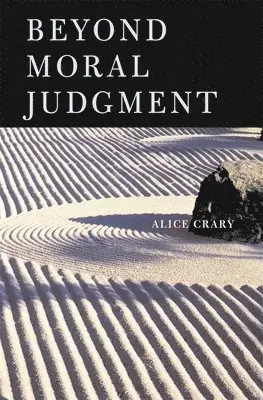
What is moral thought and what kinds of demands does it impose? Alice Crary's Beyond Moral Judgment claims that even the most perceptive contemporary answers to these questions offer no more than partial illumination, owing to an overly narrow focus on judgments that apply moral concepts (for example, "good," "wrong," "selfish," "courageous") and a corresponding failure to register that moral thinking includes more than such judgments.Drawing on what she describes as widely misinterpreted lines of thought in the writings of Wittgenstein and J. L. Austin, Crary argues that language is an inherently moral acquisition and that any stretch of thought, without regard to whether it uses moral concepts, may express the moral outlook encoded in a person's modes of speech. She challenges us to overcome our fixation on moral judgments and direct attention to responses that animate all our individual linguistic habits. Her argument incorporates insights from McDowell, Wiggins, Diamond, Cavell, and Murdoch and integrates a rich set of examples from feminist theory as well as from literature, including works by Jane Austen, E. M. Forster, Tolstoy, Henry James, and Theodor Fontane. The result is a powerful case for transforming our understanding of the difficulty of moral reflection and of the scope of our ethical concerns.