LÄS MER OM PRODUKTENProduktinformation
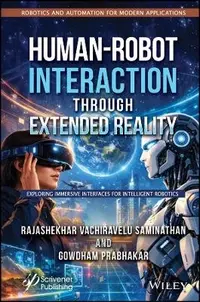
Discover how extended reality is transforming human-robot collaboration into a seamless, shared experience of perception, decision-making, and embodied action at the forefront of the next generation of intelligent, human-centered robotics. Extended reality technologies are influencing the way humans perceive, interact, and collaborate with robotic systems. From industry to medicine, human-robot interaction and extended reality have evolved, enabling humans to use it as a medium for shared perception, decision-making, and embodied action. This authored book provides an exploration of how extended reality technologies serve as powerful interaction media for human-robot collaboration. It covers how immersive technologies enhance communication, perception, and shared decision-making between humans and intelligent robotic systems. Covering fundamental concepts and the evolution of human-robot interaction, the book systematically introduces extended reality and explains how sensing, visualization, multimodal feedback, and digital twins enable human-robot interaction through extended reality. This essential guide is a deep dive into a pivotal moment in both robotics and immersive technology, positioning extended reality-enabled human-robot interaction as a central pillar in the next generation of intelligent, collaborative, and human-centered robotic systems. Readers will find the book: Explores the differences between different extended reality technologies;Addresses the absence of a unified, structured framework that integrates human- robot interaction with the rapidly expanding domain of extended reality;Explains how immersive interfaces, sensing modalities, digital twins, cognitive ergonomics, and robot control strategies can be systematically combined to enable effective human-robot collaboration.Audience Academics, researchers, robotics engineers, and extended reality developers interested in the applications of human-robot interaction.