LÄS MER OM PRODUKTENProduktinformation
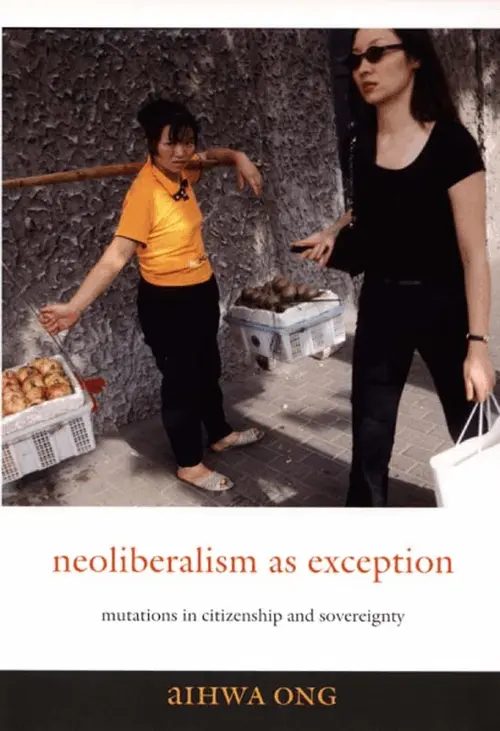
Neoliberalism is commonly viewed as an economic doctrine that seeks to limit the scope of government. Some consider it a form of predatory capitalism with adverse effects on the Global South. In this groundbreaking work, Aihwa Ong offers an alternative view of neoliberalism as an extraordinarily malleable technology of governing that is taken up in different ways by different regimes, be they authoritarian, democratic, or communist. Ong shows how East and Southeast Asian states are making exceptions to their usual practices of governing in order to position themselves to compete in the global economy. As she demonstrates, a variety of neoliberal strategies of governing are re-engineering political spaces and populations. Ong's ethnographic case studies illuminate experiments and developments such as China's creation of special market zones within its socialist economy; pro-capitalist Islam and women's rights in Malaysia; Singapore's repositioning as a hub of scientific expertise; and flexible labor and knowledge regimes that span the Pacific.Ong traces how these and other neoliberal exceptions to business as usual are reconfiguring relationships between governing and the governed, power and knowledge, and sovereignty and territoriality. She argues that an interactive mode of citizenship is emerging, one that organizes people-and distributes rights and benefits to them-according to their marketable skills rather than according to their membership within nation-states. Those whose knowledge and skills are not assigned significant market value-such as migrant women working as domestic maids in many Asian cities-are denied citizenship. Nevertheless, Ong suggests that as the seam between sovereignty and citizenship is pried apart, a new space is emerging for NGOs to advocate for the human rights of those excluded by neoliberal measures of human worthiness.