LÄS MER OM PRODUKTENProduktinformation
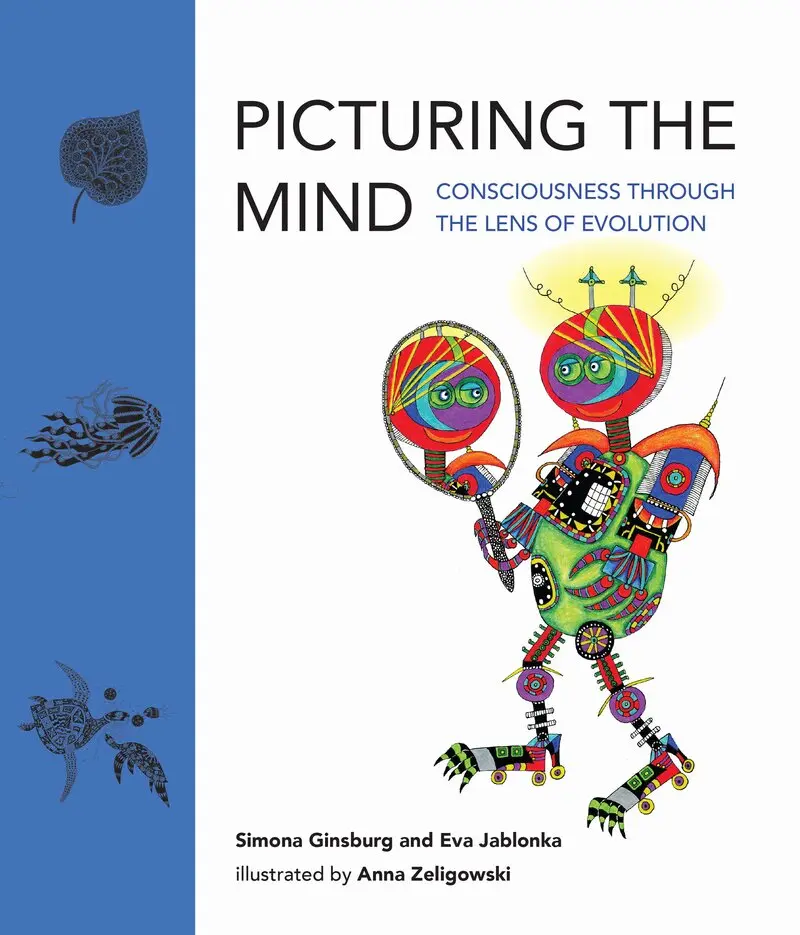
Consciousness in all its possible human and nonhuman varieties, explored through words and images. What is consciousness, and who (or what) is conscious-humans, nonhumans, nonliving beings? How did consciousness evolve? Picturing the Mind pursues these questions through a series of "vistas"-short, engaging texts by Simona Ginsburg and Eva Jablonka, accompanied by Anna Zeligowski's lively illustrations. Taking an evolutionary perspective, Ginsburg and Jablonka suggest that consciousness can take many forms and is found not only in humans but even in such animals as octopuses (who seem to express emotions by changing color) and bees (who socialize with other bees). They identify the possible evolutionary marker of the transition from nonconscious to conscious animals, and they speculate intriguingly about aliens and artificial intelligence. Each picture and text serves as a starting point for discussion. The authors consider, among other things, what it's like to be a bat (and then later, what it's like to be a bat in virtual reality); ask if the self is like a hole in a doughnut; report that women, children, and nonwhite men were once thought by white men to be less richly conscious; and explore what sets humans apart-is it music, toolmaking, cooperative parenting, blushing, sentience, symbolic language? In Picturing the Mind, questions suggest answers.