LÄS MER OM PRODUKTENProduktinformation
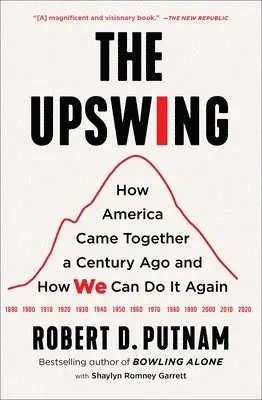
From the author of Bowling Alone and Our Kids, a "sweeping yet remarkably accessible" (The Wall Street Journal) analysis that "offers superb, often counterintuitive insights" (The New York Times) to demonstrate how we have gone from an individualistic "I" society to a more communitarian "We" society and then back again, and how we can learn from that experience to become a stronger more unified nation.Deep and accelerating inequality; unprecedented political polarization; vitriolic public discourse; a fraying social fabric; public and private narcissism-Americans today seem to agree on only one thing: This is the worst of times. But we've been here before. During the Gilded Age of the late 1800s, America was highly individualistic, starkly unequal, fiercely polarized, and deeply fragmented, just as it is today. However as the twentieth century opened, America became-slowly, unevenly, but steadily-more egalitarian, more cooperative, more generous; a society on the upswing, more focused on our responsibilities to one another and less focused on our narrower self-interest. Sometime during the 1960s, however, these trends reversed, leaving us in today's disarray. In a "magnificent and visionary book" (The New Republic) drawing on his inimitable combination of statistical analysis and storytelling, Robert Putnam analyzes a remarkable confluence of trends that brought us from an "I" society to a "We" society and then back again. He draws on inspiring lessons for our time from an earlier era, when a dedicated group of reformers righted the ship, putting us on a path to becoming a society once again based on community. This is Putnam's most "remarkable" (Science) work yet, a fitting capstone to a brilliant career.