LÄS MER OM PRODUKTENProduktinformation
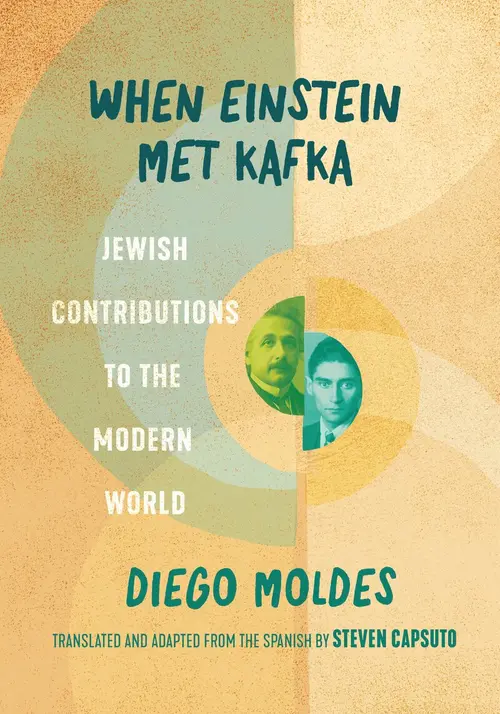
In April 1911, Prague artists, writers, and intellectuals often gathered nightly at the Café Louvre, an intellectual center where music was played and high-level discussions were held. Many of the attendees were German-speaking Jews, such as Franz Kafka and his faithful friend Max Brod, Hugo Bergmann, Oskar Kraus, Franz Werfel, the mathematician Georg Pick, and a new arrival to the city, thirty-two-year-old Albert Einstein. Is it possible that Kafka and Einstein met and exchanged ideas? Did they influence each other from a philosophical or deep-thinking perspective? In neither Kafka's nor Einstein's correspondence there is not even the slightest mention of each other. But Einstein and Kafka, two icons of our modern era, serve as the starting point for this book on the enormous contributions in the fields of the empirical sciences, humanities, letters, and arts by individuals of Jewish origin in modernity. In this book, the reader will encounter numerous names in the pages that all spring from the fountainhead of these two antecedents, the Einsteinian and the Kafkian.While Jews account for 0.2 percent of the world's population and no more than 2.5 percent of any country except Israel, they have made some of the greatest contributions to Western Culture in diverse fields that range from physics and philosophy to music and art. One register of these contributions is the Nobel Prizes: from their first recipients in 1901, 26 percent of awardees in the Nobel's six fields - among them, physics, physiology/medicine, and economics - have been Jews. What accounts for the extraordinary breadth of these achievements? This is a question that Diego Moldes examines in When Einstein Met Kafka.His answers include the history of Jewish culture itself, whether religious or secular, with its emphasis on literacy, learning, and especially inquiry and questioning. Until the European Enlightenment in the 18th century, Jews did not have full citizenship and civil rights - they were barred from universities, from government, and from entire professions. The Enlightenment opened the doors!Despite the outbreaks of violent anti-Semitism - or what Diego Moldes calls Judeophobia - and continuing discrimination in all Western countries, Jews now had legal rights, and they persevered. In a near-encyclopedic fashion, he profiles just how thousands of individual Jews, by name, made original contributions to fields as diverse as medicine, artificial intelligence, philosophy, history, economics, business, world finance, computing, sports, film, architecture, and more! The book itself is an extraordinary achievement, the result of twenty years of intensive research, yet written in an immensely engaging style that has been translated and adapted for English readers from the Spanish by Steven Capsuto.